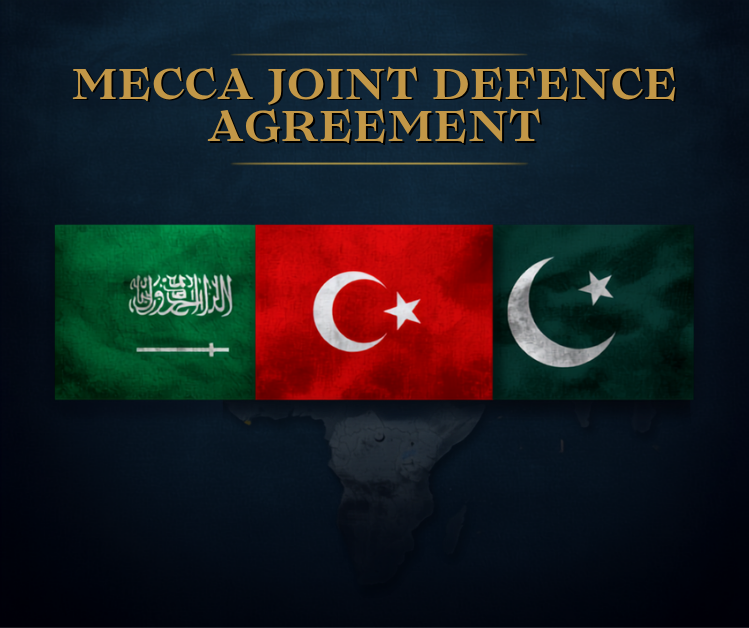
On August 7, 2026, Saudi Arabia, Turkey and Pakistan signed the Mecca Joint Defence Agreement (MJDA) in the holy city of Mecca. The core commitment is short and direct: an armed attack against any one of the three countries will be treated as an attack against all three. The deal was sealed by Saudi Crown Prince Mohammed bin Salman, Turkish President Recep Tayyip Erdoğan, and Pakistani Prime Minister Shehbaz Sharif, against the backdrop of a wider regional war involving Iran that began in February 2026.
What Is the Mecca Joint Defence Agreement?
The Mecca Joint Defence Agreement is a trilateral collective-defense pact between Saudi Arabia, Turkey and Pakistan. Its central clause states that any armed attack against one member “shall be regarded as an attack against them all,” committing the other two to respond. Beyond that mutual-defense pledge, the agreement also opens the door to closer military cooperation: intelligence sharing, joint training and exercises, and collaboration across each country’s defense industries.
Officials have been careful to frame it as defensive rather than offensive. A Turkish government source described the pact as “purely defensive in nature,” and President Erdoğan said afterward that it targets no specific country and remains open to other nations that want to join.
Who Signed It, and Where
The signing took place at Al-Safa Palace in Mecca, during what the three governments called the Makkah Al-Mukarramah Summit for Joint Defence. Each leader was accompanied by his foreign and defense ministers. Choosing Islam’s holiest city for the signing was widely read as a deliberate move to give the pact extra symbolic and religious weight, on top of its military substance.
From a Bilateral Deal to a Trilateral Alliance: The Background
The Mecca agreement didn’t appear out of nowhere. It builds directly on the Strategic Mutual Defence Agreement (SMDA) that Saudi Arabia and Pakistan signed on September 17, 2025, at Al-Yamamah Palace in Riyadh. That bilateral deal already committed both countries to treat an attack on either one as an attack on both — Pakistan has trained and advised Saudi forces for decades, and the two militaries are already deeply intertwined.
What changed in August 2026 is that Turkey formally joined that framework, turning a two-country pact into a three-country one. Turkish-Pakistani military ties are also long-standing: the two countries have exchanged warships and training aircraft, and in 2023 Saudi Arabia signed what Turkey called its largest-ever defense export contract, buying Turkish combat drones.
Why Now? The Regional Context Behind the Pact
Timing matters here. Since the United States and Israel struck Iran on February 28, 2026, the wider region has been in an escalating conflict. Saudi Arabia has absorbed repeated missile and drone attacks from Iran and its allies, including Yemen’s Houthi movement, and has seen its energy shipments threatened. For a country whose economy and long-term development plans depend heavily on secure oil exports, that’s a direct threat — and it has also raised uncomfortable questions in Riyadh about how far it can still rely on its traditional U.S. security guarantee.
Turkey and Pakistan haven’t faced attacks on the same scale, but both have strong reasons to want the conflict contained: Turkey borders the region and has its own tensions with Israel over Gaza, while Pakistan — already dealing with its own security and economic pressures — has a long-standing strategic and religious relationship with Saudi Arabia worth protecting.
What Each Country Brings to the Table
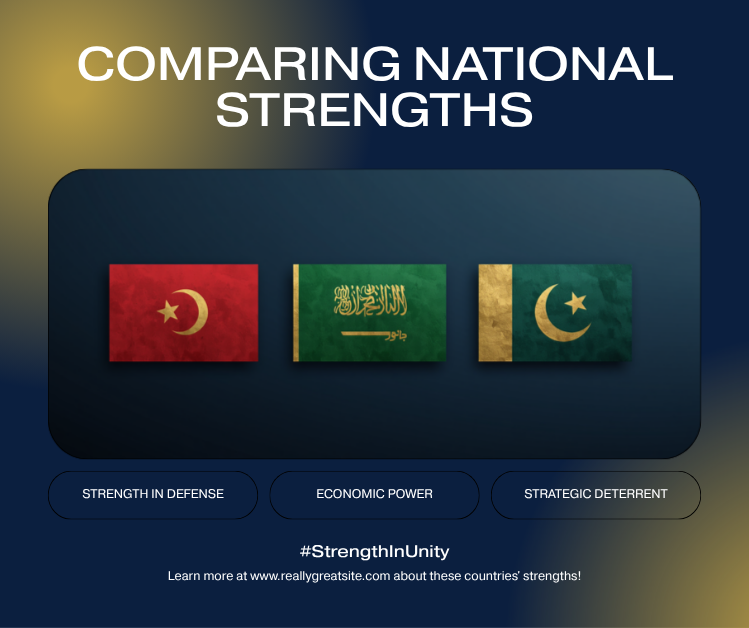
Analysts describe the pact as combining three very different — and complementary — sources of strength:
- Turkey: NATO’s second-largest standing army, plus a fast-growing, increasingly self-sufficient defense industry (drones, armored vehicles, naval systems).
- Saudi Arabia: The world’s top oil exporter, with the financial firepower to fund joint procurement, defense-industrial investment, and reconstruction.
- Pakistan: The only Muslim-majority nuclear-armed state, with a large, combat-experienced military and decades of training relationships across the Gulf.
One regional security analyst summed it up as Turkey’s defense-industrial capability, Saudi Arabia’s financial muscle, and Pakistan’s military experience and strategic deterrent, combined under one framework.
Does the Mecca Agreement Actually Strengthen Their Defense?
In practical terms, yes — on paper the pact gives all three countries a credible deterrent they didn’t fully have alone. Pakistan’s nuclear status now sits, at least politically, behind Saudi Arabia’s and Turkey’s security calculations for the first time in a formal trilateral framework. Saudi Arabia gains partners with real combat capacity and defense manufacturing at a moment its own air defenses are being tested. Turkey gains closer ties to two Gulf and South Asian powers and a bigger role in regional security architecture.
That said, several defense analysts caution against reading it as a fully binding, NATO-style guarantee. The public joint statement does not spell out exactly what obligations each country has accepted, what force levels or response times are expected, or what triggers collective action beyond the general “attack on one is an attack on all” language. Until those details (if they exist) are tested or disclosed, the agreement functions more as a strong political and strategic signal than a fully codified military treaty. Several outlets have framed it plainly as a warning to Tehran: another major attack on Saudi Arabia could, in theory, invoke the pact and pull Pakistan and Turkey directly into the conflict — a scenario Iran would presumably want to avoid.
How Iran and Israel Have Reacted
Iran’s first official reaction was dismissive. Ebrahim Rezaei, a member of the Iranian parliament’s National Security and Foreign Policy Committee, said on social media that “a paper agreement with Turkey and Pakistan will not bring [Saudi Arabia] security, just as decades of one-sided dependence on the Americans failed to do so,” and urged Riyadh to rethink its policies rather than lean on outside pacts. Iranian Foreign Minister Abbas Araghchi separately posted that Iran’s armed forces had shown their strength against what he called the world’s most expensive military, and called on Muslim-majority countries to rely on themselves rather than on outside partners — though it wasn’t immediately clear if that comment was specifically about the Mecca agreement.
Israel has not issued a formal government reaction, but regional analysts have noted that the pact complicates Israel’s freedom to act militarily against its neighbors without weighing a potentially wider response from three well-armed Sunni Muslim states. Turkey already has its own frictions with Israel over the Gaza war and Syria, and some commentary has framed the Mecca agreement as one sign of a broader realignment taking shape between Israel and Iran on one side, and a Turkey-Saudi-Pakistan grouping on the other — though the three signatories have been careful in public statements not to frame the pact as targeting either country by name.
Is This a NATO-Style Alliance?
Not exactly, according to most regional security specialists. Mansoor Ahmed, a defense analyst at the Australian National University’s Strategic and Defence Studies Centre, has described the Mecca Joint Defence Agreement as better understood as a framework for regional security and defense cooperation, rather than an alliance directly comparable to NATO. NATO’s Article 5 sits inside a permanent, integrated command structure with decades of joint planning, standardized equipment, and formal accession procedures. The MJDA, by contrast, is a young framework — its exact command structure, decision-making process, and rules of engagement have not been made public.
What it does share with NATO is the basic principle: collective deterrence through a mutual-defense clause — which is why several outlets have already nicknamed it a “Sunni NATO.” Turkey, itself a NATO member, has said the new pact does not contradict or replace its existing NATO commitments, describing the Mecca framework as an addition to its other security relationships rather than a substitute for them. Saudi officials have also pushed back on framing the deal as a sectarian bloc or a trigger for a regional arms race: Saudi Deputy Minister for Public Diplomacy Rayed Krimly said the agreement was not linked to any nuclear ambitions and does not represent a military axis.
Whether the Mecca pact evolves into something closer to a formal alliance, or stays a looser coordination framework, will depend on how the three governments build it out over the next few years — and, realistically, on whether it’s ever actually tested.
How Long Will the Mecca Joint Defence Agreement Last?
As of publication, none of the three governments has disclosed a fixed expiry date or renewal term for the Mecca Joint Defence Agreement. The joint statement frames it as an open-ended commitment to “collective security” and regional “peace, security and stability,” with no sunset clause mentioned publicly.
That’s consistent with how the underlying Saudi-Pakistan Strategic Mutual Defence Agreement of September 2025 was also presented — as a standing commitment rather than a fixed-term treaty. Most mutual-defense pacts of this kind (NATO’s Article 5 included) are open-ended by design, remaining in force until a signatory formally withdraws or the parties renegotiate it. Based on the public statements so far, the Mecca agreement appears to follow that same open-ended model, meaning its practical lifespan will likely be determined by regional politics and each government’s ongoing interest in it, rather than by any fixed calendar date.
Can Other Countries Join the Pact?
Yes — at least in principle. Turkish officials have said other countries can join the framework, and President Erdoğan has stated that the agreement targets no country and remains open to other nations seeking regional peace and stability. No formal accession process has been made public yet, and no additional country has joined as of this writing. Egypt, notably, took part in related regional talks but is not currently a party to the Mecca agreement itself.
What This Means for Business and Regional Stability
For businesses operating in or trading with the Gulf, Turkey, and Pakistan, the pact is worth watching less as a military development and more as a stability signal. A credible collective-defense framework — even an informal one — tends to reduce some of the geopolitical risk premium investors attach to the region, particularly around Gulf energy exports and the trade routes that run through it. It also hints at deeper defense-industrial cooperation between Turkey, Saudi Arabia and Pakistan, which could open new supply-chain and joint-venture opportunities in defense manufacturing, logistics, and related sectors over the coming years.
Frequently Asked Questions
What is the Mecca Joint Defence Agreement?
It’s a trilateral collective-defense pact signed on August 7, 2026, by Saudi Arabia, Turkey and Pakistan, under which an attack on one member is treated as an attack on all three.
Which countries signed the Mecca agreement?
Saudi Arabia, Turkey and Pakistan. It builds on a bilateral Saudi Arabia-Pakistan defense pact signed in September 2025.
Is the Mecca Joint Defence Agreement the same as a NATO-style alliance?
No. Analysts describe it as a regional security and defense-cooperation framework rather than a fully codified alliance like NATO, though it shares the same basic collective-deterrence principle.
How long is the Mecca Joint Defence Agreement valid for?
No fixed term or expiry date has been publicly disclosed. Based on public statements, it appears to be an open-ended commitment, similar in structure to other mutual-defense pacts.
Can other countries join the agreement?
Turkish officials have said the pact is open to other countries, though no formal accession process has been announced and no new members have joined so far.
Bottom Line
The Mecca Joint Defence Agreement formalizes and expands a defense relationship that Saudi Arabia and Pakistan already had, now bringing in Turkey’s military and industrial weight at a moment of real regional tension. It genuinely adds deterrent strength on paper — nuclear, financial, and industrial capability combined under one roof — but its real-world impact will depend on details the three governments haven’t yet made public, and on whether the commitment is ever actually tested. For now, expect it to function primarily as a strong political signal of regional realignment, with its open-ended term meaning it’s designed to last indefinitely rather than expire on a set date.