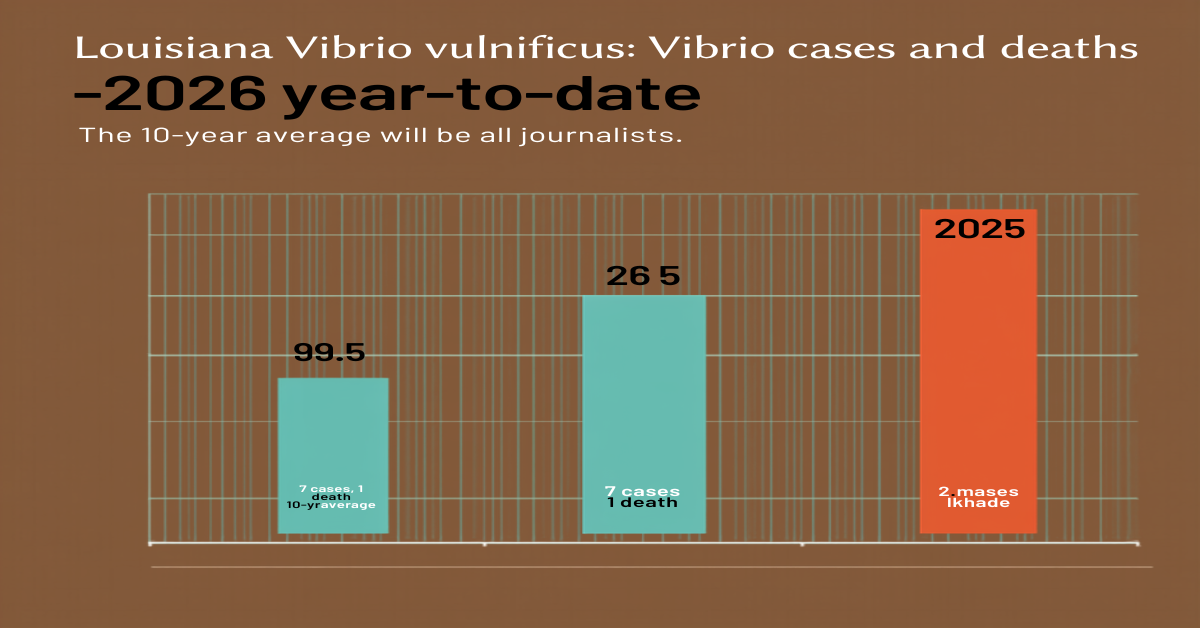
Louisiana has reported nine cases of Vibrio vulnificus — the so-called “flesh-eating bacteria” — so far in 2026, and five of those patients have died. That puts the state on pace to far outstrip its own 10-year average of roughly seven cases and one death per year, according to the Louisiana Department of Health (LDH). Every case this year has involved a wound exposed to seawater, and every patient had an underlying health condition. It’s a small number of cases in absolute terms, but the death toll relative to that number — five of nine — is what’s driving the state’s public health warning, and it’s part of a broader pattern showing up across the Gulf Coast and beyond this summer.
What’s Happening in Louisiana Right Now?
On August 6, 2026, the Louisiana Department of Health confirmed nine Vibrio vulnificus infections statewide: all nine patients were hospitalized, and five died. The agency is urging residents to take precautions around brackish and coastal water, and around raw or undercooked shellfish, for the rest of the warm-water season, which typically runs May through October. This isn’t a one-year blip, either — Louisiana logged an even sharper spike in 2025, with 26 cases and five deaths, well above its historical norm.
What Is Vibrio Vulnificus?
Vibrio vulnificus is a bacterium that lives naturally in warm, brackish coastal water. It isn’t contagious between people. It infects people two main ways: through an open wound (a cut, scrape, or recent surgical site) exposed to seawater, or by eating raw or undercooked shellfish, especially oysters. Once inside the body, it can cause a wound infection, a gastrointestinal illness, or — in the most severe cases — a bloodstream infection (sepsis). About one in five people who develop a serious infection dies, sometimes within a day or two of symptoms starting, and survivors can require intensive care or limb amputation.
The nickname “flesh-eating bacteria” refers to necrotizing fasciitis, a rapid destruction of skin and soft tissue that can occur in severe wound infections — it’s a real and serious risk with Vibrio vulnificus, but it’s not the typical outcome for every case. About a dozen different Vibrio species can cause human illness, collectively known as vibriosis, but V. vulnificus is considered the most dangerous of them because of how quickly it can progress and how high its fatality rate is compared with the milder, more common Vibrio species.
How This Year’s Outbreak Compares to Past Years
The numbers are the clearest way to see how unusual this is. Louisiana’s typical year sees about seven cases and one death. In 2025, that jumped to 26 cases and five deaths for the full year. In 2026, the state has already matched that death toll — five — in just the cases reported so far, with months of warm-water season still ahead.
Who Is Most at Risk?
Anyone can be infected, but severe illness and death cluster heavily among people with certain underlying conditions. LDH and the CDC identify the highest-risk groups as people with liver disease, cancer, diabetes, HIV, or thalassemia; people on immune-suppressing therapy; people taking medication that reduces stomach acid; and people who’ve had recent stomach surgery. Notably, all nine of Louisiana’s 2026 patients had an underlying health condition — a pattern consistent with prior years and with national data. That doesn’t mean healthy people are risk-free, only that the odds of a mild infection turning severe rise sharply once one of these conditions is in the picture, which is why LDH’s guidance leans so heavily on avoidance for anyone in a higher-risk group rather than treatment after the fact.
Symptoms to Watch For
A wound infection can bring fever, redness, pain, swelling, warmth, skin discoloration, or drainage around the injury site. A bloodstream infection is more dangerous and can cause fever, chills, dangerously low blood pressure, and blistering skin lesions. Gastrointestinal infection, usually from eating contaminated shellfish, causes watery diarrhea, stomach cramps, nausea, vomiting, fever, and chills. Anyone with a wound that was exposed to brackish or salt water and starts showing these signs should seek medical care immediately and tell the provider about the water exposure — early treatment matters a great deal with this infection.
Why Cases Are Rising: The Climate Connection Most Coverage Skipped
Most of the wire coverage of Louisiana’s outbreak this week has stuck closely to LDH’s press release: case counts, symptoms, and safety tips. What’s largely missing from that coverage is the research on why Vibrio vulnificus is becoming more common in the first place. Peer-reviewed research tracking 30 years of Eastern U.S. infection data found that V. vulnificus wound infections increased roughly eightfold between 1988 and 2018, and that the northern edge of the bacterium’s range has crept northward by about 30 miles a year since 1998 — a shift researchers tie directly to warming coastal waters. Some modeling suggests infections could become possible in every Eastern U.S. state by the end of the century under continued warming.
That range expansion isn’t hypothetical: cases have already turned up this year in Long Island, New York waters that historically wouldn’t have supported the bacteria, and Maryland has also reported a rise in cases around the Chesapeake Bay. There’s also a storm connection specific to the Gulf: Louisiana saw Vibrio clusters after Hurricane Katrina’s 2005 flooding, and Florida recorded its highest-ever single-year case count after 2024’s Hurricane Helene, when storm surge and standing floodwater created ideal conditions for the bacteria. None of that context appeared in most of this week’s Louisiana coverage.
It’s Not Just Louisiana
The other gap in most local coverage is the national and regional picture. The CDC estimates 150 to 200 Vibrio vulnificus cases are reported nationally each year, with roughly half occurring in Gulf states — Texas, Louisiana, Mississippi, Alabama, and Florida. Florida, which has the highest infection rate in the country, recorded two deaths so far in 2026, after 19 deaths in 2024 and five in 2025. Reading Louisiana’s numbers next to Florida’s makes clear this is a regional, multi-state pattern this summer, not an isolated Louisiana event — something none of the wire stories connected.
The Oyster Industry Is Watching Closely Too
One angle almost entirely absent from this week’s national coverage: the economic side. Oysters are a multi-million-dollar industry in Louisiana and a genuine cultural staple along the Gulf Coast, and rising Vibrio case counts put both the industry and consumers in an uncomfortable spot. Some Louisiana restaurants have already responded on their own — Iberia Parish restaurant owner Elaine Buteau, for instance, has said her restaurant stopped serving raw oysters altogether given the summer risk, a choice she says many customers now appreciate. That kind of quiet, restaurant-by-restaurant risk management is happening across the coast even though it rarely makes it into outbreak reporting, which tends to focus purely on the case-and-death count.
How to Protect Yourself
LDH’s guidance is straightforward: stay out of brackish or salt water entirely if you have any open wound, including cuts, scrapes, recent surgical sites, or piercings. If you might be exposed anyway, cover the wound with a waterproof bandage first. Wash any wound thoroughly with soap and clean water as soon as possible after contact with coastal water or raw seafood. Cook shellfish thoroughly, wear gloves when handling raw shellfish, and keep raw seafood separate from other food. People in the higher-risk categories above should consider avoiding raw oysters and undercooked shellfish altogether during warm-water months.
Frequently Asked Questions
How many Vibrio vulnificus cases has Louisiana had in 2026?
Nine cases have been reported as of early August 2026, with five deaths — all nine patients were hospitalized.
Is Vibrio vulnificus contagious?
No. It isn’t spread person-to-person. It’s contracted through wound exposure to contaminated water or by eating raw or undercooked shellfish.
What is the survival rate for Vibrio vulnificus?
About four in five people with a serious infection survive, but roughly one in five dies, according to CDC data — sometimes within a day or two of symptom onset.
Why are Vibrio vulnificus cases increasing?
Research links the rise to warming coastal waters, which expand the bacteria’s range and season, plus storm-related flooding events that create favorable conditions for outbreaks.
Is it safe to eat oysters in Louisiana right now?
Thoroughly cooked shellfish is considered low-risk. Health officials specifically advise people with liver disease, weakened immune systems, or other high-risk conditions to avoid raw or undercooked oysters during warm-water months.
Bottom Line
Louisiana’s 2026 numbers — nine cases, five deaths, and months of warm water still ahead — are a real and current public health concern, and the state’s own advisory covers the immediate precautions well. But most of this week’s coverage has repeated the same press-release facts without connecting them to the bigger pattern: a documented, research-backed rise in Vibrio vulnificus tied to warming waters, a similar surge playing out in Florida and Maryland at the same time, and a known link between hurricane flooding and past Louisiana outbreaks. Understanding those connections doesn’t change the safety advice, but it does explain why “a rare bacteria” is showing up more often — and in more places — than it used to.