The Step Up Scholarship — officially run by the nonprofit Step Up For Students — remains one of the largest school-choice scholarship programs in the United States, helping hundreds of thousands of Florida families cover private school tuition, homeschool materials, and specialized learning support. If you searched for this program before, you may have run into outdated or mixed-up details about who it serves. This guide is fully refreshed for the 2026–27 school year, covering eligibility, the application process, how to use your Step Up Scholarship login, key deadlines, and the documents you’ll need on hand.
What Is the Step Up Scholarship?
Step Up For Students is a state-approved scholarship funding organization based in Florida. It does not hand out a single scholarship — instead, it administers several state-funded and tax-credit-funded scholarship programs on behalf of Pre-K through 12th grade students across the state. Families sometimes call the whole umbrella program the “Step Up Scholarship,” but it’s really a family of programs designed to give parents more control over how and where their child is educated.
The organization works directly with the Florida Department of Education and thousands of participating private schools, homeschool vendors, and service providers. You can read more about the organization’s full mission on the official Step Up For Students website.
Step Up For Students: The Scholarship Programs Explained
Before you apply, it helps to know which specific program fits your child, since each one has its own rules:
- Family Empowerment Scholarship for Educational Options (FES-EO) — helps families pay private school tuition and fees, open to Florida students regardless of household income under the state’s universal eligibility expansion.
- Florida Tax Credit Scholarship (FTC) — a donor-funded scholarship for private school tuition, historically aimed at lower- and middle-income households.
- Family Empowerment Scholarship for Unique Abilities (FES-UA) — for students with a qualifying disability or unique ability diagnosis, covering tuition, therapy, and other approved services.
- Personalized Education Program (PEP) — an education savings account (ESA) style scholarship for homeschooling families, used for curriculum, tutoring, and approved educational materials through the MyScholarShop marketplace.
- Hope Scholarship — for public school students who have experienced bullying, harassment, or violence, allowing a transfer to a participating private school.
Each program has its own funding cap, so checking current capacity before you apply saves time.
Which Program Should You Choose?
Most of the confusion around the Step Up Scholarship comes from families not realizing these are separate programs with separate rules. If your child is currently in public school and you want to move them to a private school, FES-EO or FTC is the starting point. If your child has a diagnosed disability and needs therapies, tutoring, or specialized equipment on top of tuition, FES-UA is built for that. If you’re homeschooling and want a flexible budget for curriculum and enrichment rather than a private school seat, PEP functions more like a spending account than a traditional scholarship. And if your child is being bullied or has experienced violence at their current public school, the Hope Scholarship exists specifically to fund a fast transfer. Picking the right program before you start your EMA application saves you from having to restart later.
Step Up Scholarship Eligibility Requirements
General eligibility depends on which program you’re applying for, but most share these baseline requirements:
- The student must be a Florida resident, from Pre-K through 12th grade depending on the program.
- For FES-EO and FTC, the family must meet Florida’s current income and residency guidelines (FES-EO is open to all Florida students under universal eligibility, though funding priority still goes to lower-income and renewal students first).
- For FES-UA, the student must have a documented qualifying disability recognized under the program’s guidelines.
- For PEP, the student must not be enrolled full-time in a public or private school and must be at least 5 years old by September 1 of the school year.
- For the Hope Scholarship, the student must currently attend a Florida public school and have an incident report on file for bullying, harassment, or violence.
Because Florida law requires priority for renewing students and specific groups (such as students in foster care), new applicants are approved on a first-come, first-served basis once renewals and priority cases are processed.
A few groups also receive built-in legal priority regardless of income, including students in foster or out-of-home care, dependents of active-duty U.S. Armed Forces members, and students who have experienced bullying or harassment in public school. If your family fits one of these categories, it’s worth flagging it clearly in your EMA application, since it can affect how quickly your application is processed and whether you qualify for a deadline exception outside the standard application window.
How to Apply for the Step Up Scholarship (Step-by-Step)
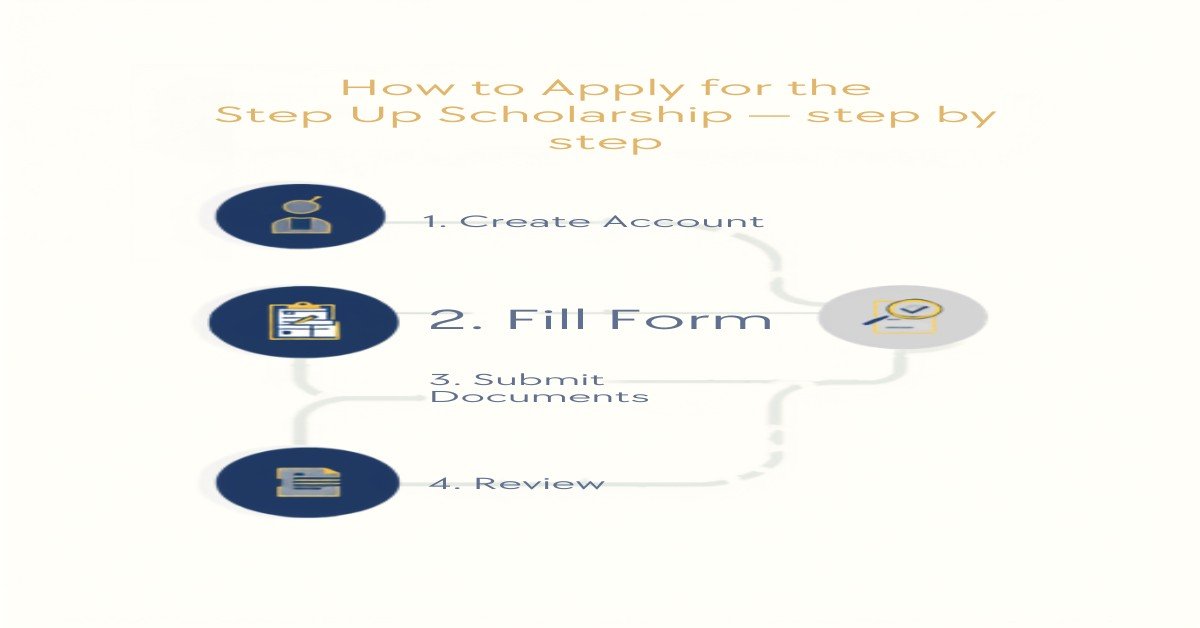
Applying is done entirely online through the EMA (Family Portal) system. Here’s the process for the 2026–27 cycle:
- Create or log in to your EMA account. New families register with an email address; returning families use their existing login.
- Add your student(s) to your family profile. Each child needs their own student record before you can start an application.
- Choose the scholarship program that fits your child — FES-EO, FTC, FES-UA, PEP, or Hope.
- Fill in household and income details. Even families that don’t need income-based priority should complete this section, since skipping it can affect funding priority.
- Upload required documents — residency proof, income verification (if applicable), and any disability or incident documentation.
- Review and submit your application before the relevant deadline.
- Track your status through your EMA dashboard, where you’ll see whether your application is pending, confirmed, or needs additional documents.
Step Up Scholarship Login: Accessing Your EMA Account

Every applicant and current scholarship family manages their account through the EMA family portal — this is the “Step Up Scholarship login” most parents are searching for. A few tips to avoid the most common login headaches:
- Each family should have only one EMA account. Creating a second account for the same household can cause processing delays.
- If your username or password isn’t working, use the “Forgot Username” or “Forgot Password” links on the login screen rather than creating a new profile.
- Saved browser passwords sometimes stop working after a system update — if that happens, reset your credentials instead of guessing.
- Step Up For Students will never contact you by phone, text, or email asking for your login credentials or banking details — treat any such request as a scam.
You can find the official login screen and account recovery tools on the Step Up For Students login page. If you’re stuck, the organization’s support line and live chat (listed on that same page) can walk you through recovery.
Documents and Deadlines for the 2026–27 Cycle
Applications for the 2026–27 school year opened in January 2026 and stay open on a rolling basis until each program’s funding is exhausted. A few dates matter most:
- Priority deadline: Renewing and new families who apply by the priority date get processed first and have the best shot at funding before capacity fills.
- Standard application window: New applications generally remain open into the fall for programs that still have capacity.
- Quarterly attestation: Once confirmed, families must complete a quarterly confirmation in EMA verifying the student is not enrolled full-time in public school, in order to keep receiving funds.
Typical documents you’ll need to upload include:
- Two forms of Florida residency proof (utility bill, lease, or similar, dated within the last two months)
- A birth certificate or passport for age verification, especially for incoming kindergarten or first-grade students
- Income documentation if you’re applying under income prioritization
- Diagnosis, IEP, or 504 plan documentation for FES-UA applicants
- An incident or police report for Hope Scholarship applicants
Because deadlines and capacity change program by program, always confirm the current dates on your EMA dashboard before you submit.
Common Mistakes That Delay a Step Up Scholarship Application
Every application cycle, Step Up For Students processes a huge volume of new and renewal applications, and a small handful of avoidable mistakes account for most of the delays:
- Creating a duplicate EMA account instead of recovering login access to an existing one — this is the single biggest cause of processing confusion.
- Skipping the income section entirely, even when a family doesn’t need income-based priority, which can push the application into a lower priority tier.
- Uploading outdated residency documents — recurring bills or statements need to be dated within roughly two months of submission.
- Waiting until the priority deadline to start gathering documents, rather than preparing them in advance.
- Applying for the wrong program for the child’s situation, which sometimes means restarting the whole application under the correct scholarship type.
Avoiding these five issues alone resolves most of the support tickets families run into during a typical application window.
The Impact of the Step Up Scholarship
Since its founding, Step Up For Students has grown into one of the largest school-choice programs in the country, giving families real flexibility to choose the learning environment that fits their child best — whether that’s a private school, a specialized program for a unique ability, or a fully personalized homeschool plan. For many families, the scholarship removes the single biggest barrier to switching schools: cost. It also gives students with disabilities access to therapies and services that public school budgets don’t always stretch to cover, and it gives homeschooling parents a real budget to build a curriculum around their child’s needs rather than a one-size-fits-all classroom.
If you’re comparing this program with other student aid options while you plan ahead, our guide to the BKF Engineers Scholarship covers a merit-based option worth knowing about too.
Frequently Asked Questions
Is the Step Up Scholarship only available in Florida?
Yes. Step Up For Students is a Florida-specific program administering state and tax-credit-funded scholarships for Florida residents only.
How do I access my Step Up Scholarship login if I forgot my password?
Use the “Forgot Username” or “Forgot Password” links on the official EMA login page rather than creating a second account, which can delay your application.
Can I apply for more than one Step Up scholarship program at once?
Generally, a student can only be awarded one primary scholarship program per year, though some families explore multiple options (like FES-EO and PEP) before deciding which fits best.
What happens if a program reaches capacity?
Renewal students and income-prioritized applicants are funded first. New applicants who apply after a program hits capacity may be placed on a waitlist and notified if funding opens up.
Do I need to reapply every year?
Yes. Families must complete a renewal or new application each school year and, once confirmed, submit quarterly attestations to keep funding active.
How long does it take to hear back after applying?
Processing times vary by program and time of year, but families typically see an update on their EMA dashboard within a few weeks of submitting a complete application. Missing or outdated documents are the most common reason a review takes longer than expected.
Conclusion
The Step Up Scholarship — through Step Up For Students — continues to open doors for Florida families who want more say in their child’s education, whether that means private school tuition support, resources for a student with unique abilities, or a fully personalized homeschool budget. Eligibility rules, deadlines, and program capacity shift every cycle, so the safest approach is always to apply early, keep your documents ready, and check your EMA dashboard regularly for updates. A little preparation before the application window opens — knowing which program fits your child, gathering residency and income documents ahead of time, and keeping a single, secure EMA login — makes the entire process far smoother than trying to catch up after a deadline has already passed. If you’re tracking an application elsewhere too, our guide on checking your SVMCM scholarship status covers a similar post-submission tracking process.